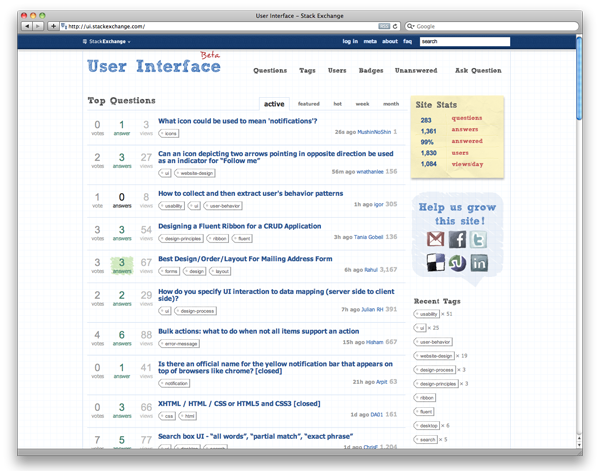
I’ve been visiting ui.stackexchange.com recently as a resource for ui/ux information. It’s a network within Stackexchange, a community powered Q&A hub that allows members to ask, answer, and rate. Here’s what I grabbed from their wiki:
The websites feature the ability for users to ask and answer questions, and through membership and active participation, to vote questions and answers up or down and edit questions and answers in a wiki fashion. Users can earn reputation points and “badges” through site participation; for example, a user is awarded 10 reputation points for receiving an “up” vote on an answer given to a question, and can receive badges for their valued contributions. By collecting reputation points, users are given more and more permissions, ranging from the ability to vote and comment on questions and answers to the ability to moderate many aspects of the site.
There have been some pretty good topics posted (284 as of today), but as with any great site, content is king, so once the community grows, it’ll be a great spot to gain some community insight.
iTunes 10 is a major release from Apple. In past updates to the application, Apple introduced only new features, but this is the first in a while where the company made some radical interface changes. The most extreme change is most notably the new dock icon, which strangely reminds me of the Windows start icon. Surely, there’s a good reason to back up the change – transition from CDs to all-digital format. But was it a good idea to change something already so memorable and associated with the iTunes brand? Since iTunes was released in 2001, the icon has consistently been a musical note on top of a compact disk. I have to admit, I haven’t been launching the app from the dock as often because my mind’s still not relating the icon to iTunes. There has been such buzz about the redesign, people have started to design their own versions and swapping them out on their own systems. Hell, there’s even a Twitter account (@itunes10icon) comically defending the change.
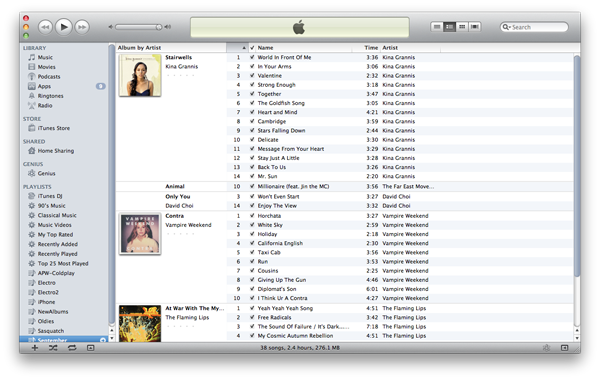
One of the newest features is a new album view that lets users see the cover of the album, in an effort to reduce redundant album titles. This view seems to only be ideal if I only have albums in my library, but in the scenario in the screenshot above, it clearly raises some issues if I only have 1 or 2 songs from an album. If there is only 1 song, only the album title is listed; 2-4 songs will show the title and artist; and the cover would only be seen if the user has at least 5 songs from that album. Chunking and drawing focus to the album and artwork, I would unnoticeably skip over the tracks that don’t have artwork because they don’t seem as important. I did notice however that this view was the default for Library, but when I changed to another playlist, I was in list view, which was a relief because my playlists don’t usually have entire albums. There is one feature that I think has the most value in this view: the ability to edit artist name or album title in-line, and have those changes apply to the entire album listing. I used to have to highlight all the tracks I wanted to edit, get info, make the changes and press apply, so reducing the workflow by more than half, makes this view a lot more useful to the user.
There have been some subtle UI changes made as well. There’s a new fatter volume bar with a shiny brushed aluminum-like scrubber, which seem to be the only instance of this type of design treatment in the entire app. One of the most obvious is the vertical layout for window controls (Close, Minimize, Maximize). Now more like a traffic light, it makes the entire application seem like it doesn’t belong to OS X, rather, like a third-party app. Because every other application running in the OS has these controls laid out horizontally, this new placement throws off the user’s perception of what they’re already used to. Maybe this is just a taste of what Apple has ready to roll out in their next OS release. There is, however, a way to revert back to the original placement:
The iconography in the left navigation has also made a minimal change. Originally, the icons were in color, and seemed to be more active and selectable. Desaturating the icons to be monochromatic makes these categories look inactive and inaccessible. They do make the application look a little more sophisticated and more content-centric in that color appears in only cover art and store images. Again, could this be a change that will be reflected in a future release of Mac OS, for instance, desaturated icons in the finder?
I went back to explore Ping, and quickly noticed that the modal that overlays when images and videos are selected is new. Instead of the dark-and-black lightbox-esque pop-up you would get when watching a trailer in the iTunes Store, this pop-up is white and has a glass-like border, reminiscent of Windows Vista and 7.
When you get to the bottom of the feed, you see text for “More…” but being used to expanding feed interactions like Facebook’s or Twitter’s, I’m expecting more content to either auto-populate when I scroll down, or have an obvious button that I can click to initiate the process. iTunes doesn’t have any type of visual clue to let the user know that text is clickable. Links are blue in Ping, but not anywhere else in the iTunes Store.
Finally, I decided to plug my iPhone in to test “improved syncing.” Visually, the capacity bar is better than it was before. The previous bar was embossed and split up in segments, which I thought was useless and added unnecessary cognitive load.
The process of syncing has also made a minor change. There is now contextual confirmation that shows “Step # of 5,” reaffirming where in the process funnel the user is. Though syncing is an automated process where the user cannot navigate backwards and forwards through (only cancel), it’s nice to let them know what’s going on in the automation, and provide some clues to allow them to predict time until completion.
Overall, there are both negative and positive changes in iTunes 10, unfortunately, more of the former than the latter. There is definitely a drive to keep innovating software at Apple, but there seems to be some disconnect when unifying all of the elements that make up one product. Sure there must be different teams working on various features (iTunes Store, App Store, Ping), but they need to design more uniformly and strictly enforce a style guide to create better usability. Have you given the new update a try yet? What do you think of the new version of iTunes?
Nick Finck posted this TED talk by John Underkoffler, chief scientist at Oblong Industries. I did research in a Fundamentals of Interface Design course taught by Axel Roesler that dealt with integrating new computing technologies, specifically multi-gestural interactions using Microsoft Surface, into the flight deck of the Boeing Dreamliner. During research, we took a closer look at Oblong’s g-speak and its use of a “spatial operating environment,” and wondered how we could conceptualize useful solutions for a commercial airline cockpit.
I agree with both John and Nick that this it isn’t far-fetched to say that this technology will be commercially available in 5 years because of the exponential pace technology is advancing. Being able to bring the digital and physical world together will definitely better user experiences in the future.
Youtube has started to roll out a UI update on its video player to complement its new description, analytics, like/dislike, save to, share, embed, and flag feature set “New Watch Page.” The player itself is Flash 10, and not HTML 5. Embedding the video on another site will still show the old player.

 The most extreme change is most notably the new dock icon, which strangely reminds me of the Windows start icon. Surely, there’s a good reason to back up the change – transition from CDs to all-digital format. But was it a good idea to change something already so memorable and associated with the iTunes brand? Since iTunes was released in 2001, the icon has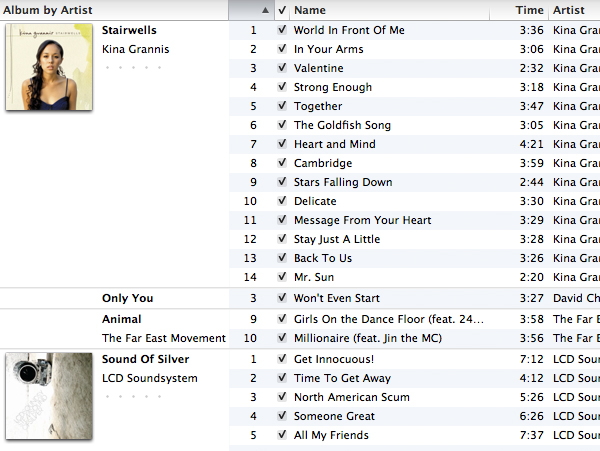

 The iconography in the left navigation has also made a minimal change. Originally, the icons were in color, and seemed to be more active and selectable. Desaturating the icons to be monochromatic makes these categories look inactive and inaccessible. They do make the application look a little more sophisticated and more content-centric in that color appears in only cover art and store images. Again, could this be a change that will be reflected in a future release of Mac OS, for instance, desaturated icons in the finder?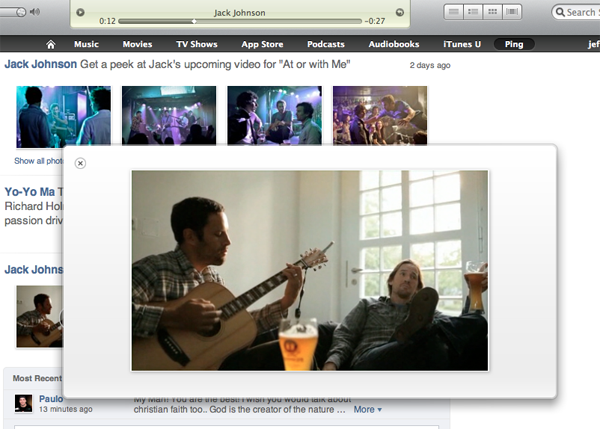
 When you get to the bottom of the feed, you see text for “More…” but being used to expanding feed interactions like Facebook’s or Twitter’s, I’m expecting more content to either auto-populate when I scroll down, or have an obvious button that I can click to initiate the process. iTunes doesn’t have any type of visual clue to let the user know that text is clickable. Links are blue in Ping, but not anywhere else in the iTunes Store.