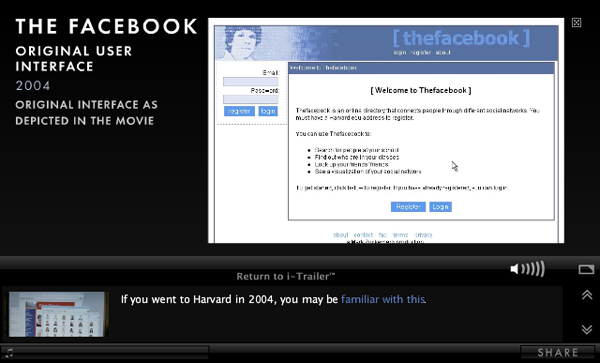
The Social Network’s new Pop-Up Videoesque i-Trailer just premiered on MySpace and allows users to click on hotspots during the video to reveal additional information or video about what they’re seeing. For instance, I didn’t know that Steve Chen, Co-Founder and CTO of YouTube used to work at Facebook when it was still a startup before he left to create the most popular online video service in the world with Chad Hurley and Jawed Karim. The i-Trailer also includes deeper links within the info that pauses the video and shows additional content like images and video:
Check out some more facts from the trailer at Mashable
I was pretty excited to update to iTunes 10 after seeing some new UI updates and features. Aside from some interface changes (I’ll save that for another post), I wanted to get started on Ping, Apple’s “social network for music.” And then I started catching up my Twitter feed to see a few running posts by @Scobleizer pointing out one significant flaw with Ping: Artist discovery. I couldn’t believe the names he was tweeting: Black Eyed Peas, Daft Punk, Madonna… So I gave it a try as well, searching around 15 headline-caliber artists, and what do you know? “Your search had no results.”
Was it too early to release Ping? Should Apple have waited a while to get more artists onboard? Definitely. After registration, Ping recommended only 12 artists to me, and I only chose 2 or 3 to follow. On top of that, I’ve been reading Facebook Connect has been axed (for now) due to “onerous terms.” On the contrary, there are features that are pretty useful – concert tickets, especially. I’ve read reports that Apple was working on a partnership with LiveNation, but after clicking on the tickets link for a Jack Johnson concert, I was redirected to Ticketmaster.com. If in-app ticket purchasing is in the horizon, I could see it being a useful tool. We’ll see what happens in a few months, but for now, Facebook Pages, with a larger database of artists and essentially offering the same content, is shining.
Facebook’s friend-finding API is generally open access, but anyone that wants to hit it an extreme number of times has to sign a deal agreeing to protect Facebook user data and limit network impact. Given the sheer size of the iTunes customer base, it’s no surprise that Facebook wanted such a deal, but apparently negotiations broke down — possibly over what Steve Jobs referred to as “onerous terms” — and Apple decided to just go ahead and use the API anyway.
Remember the days of becoming a “fan” on Facebook? As part of their new Open Graph protocol, Facebook has replaced the “Become a Fan” button to “Like,” and no, it’s not just a change for the sake of syntax. In an effort to increase social awareness, sites employing the like button can track the amount of “likes” or approvals in a similar fashion as you would see if someone likes a status update, comment, or photo. Leah Pearlman, a product manager at Facebook blogs:
This is similar to how you might rate a restaurant on a reviews site. If you go to the restaurant and have a great time, you may want to rate it 5 stars. But if you had a particularly delicious dish there and want to rave about it, you can write a review detailing what you liked about the restaurant. We think of the new “Like” feature to be the stars, and the comments to be the review.
Implementation has flourished. According to Facebook’s Developer Blog, more than 50,000 sites have implemented the “like” button as well as other social plugins in a week after launch.
Last quarter, I was in a research group for Mobile UX, headed by Dr. Judith Ramey and I proposed the topic “Geotagging Social Communication: A Location-Based Approach to Real-Time Content” for a poster project. Here are some of the key takeaways from what I’ve found:
The Geolocation Boom
The mediums of social communication have rampantly evolved through advancements in technology and an increase in user participation. In the past year, micro-blogging platform Twitter has grown 294%, social network Facebook has grown 95%, and geo-local service Foursquare has grown an astounding 519,590%. Social media has made a huge leap into mainstream media in the last several years heavily due to the astronomical amounts of content being published each day. Real-time data is becoming a staple in any social platform available because users yearn for the quick dissemination of content, but for companies as these, managing projects in the company could be difficult for the amount of data managed, and is when the use of a pmp certification austin for the employees work great. All three services share a relatively new and common feature, geolocation. By integrating GPS capabilities into mobile phones, services are able to trace the location of where the user has published content from. Several of the current major services using geolocation are: Twitter, Facebook, Brightkite, Loopt, Gowalla, and Foursquare.
Case Study: Foursquare
Foursquare is a location-based service that allows users to check-in to venues that they are currently at through text message, mobile web, and dedicated mobile apps on the iPhone, Blackberry, and Android platforms.
Founded by Dennis Crowley and Naveen Selvadurai in 2009
Crowdsourced platform that allows its users to source venue details and provide tips to do at a venue or within a city
In one year, the service has accumulated more than half a million users, 1.4 million venues, and 15.5 million check-ins (in a recent tweet, Foursquare has mentioned that they are closing in on 1,000,000 users)
Usage by platform over a period of 7 days: iPhone 67%, Android 13%, Blackberry 11%, mobile web 7%, Palm 1.5%, SMS <1%
Practicality
Using application programming interfaces (APIs) provided by these services, third-party services are able to integrate location data into their own platforms.
Vicarious.ly – real-time map that shows where users are checking-in through Foursquare and Gowalla or uploading photos to Flickr
Twitter.com – shows a map pinpointing the vicinity of your last geotagged tweet
Lufthansa Airlines – will offer location-based community services to customers that will alert them to changes in flight plans and upgrades as well as providing a community for professionals to find and meet each other
The Future
The state of geolocation and location-based services is still in its infancy, and hasn’t accumulated a large user-base adoption that it has the potential to. The amount of data that can be collected through these services is indispensable. There are lot of new services that are still being created, and the third-party applications that can be derived through APIs will interpret geographic data in new and innovative ways.



 Remember the days of becoming a “fan” on Facebook? As part of their new